Much has changed since Omicron Pi Omicron was founded over a century ago, yet the core themes of fellowship, academic excellence, community, and savoring the moment remain steadfast. These enduring values bridge generations, ensuring that the bonds of brotherhood remain strong as the world around us continues to evolve.
Origin
On November 9, 1903, a group of seven underclassmen at Clarkson decided to establish a fraternity. Keeping the idea secret, they made their debut at an 8:15 am chapel service in February 1904, proudly wearing their fraternity badges. Clarkson had only 56 students at the time, and Omicron Pi Omicron was the first Greek social organization at the college. In 1916, the fraternity merged with Kappa Epsilon Phi, which had been founded at Clarkson just a year earlier.
Purpose
“The purpose of this fraternity shall be to promote harmony and good will among its members, to bind them together for mutual help and assistance, and to further their educational and social development.” This opening statement of our constitution has been the guiding principle of our evolution for over 120 years.
The Articles of Incorporation established in 1919 affirm this purpose. “[T]he principal objects for which this corporation is formed are: [t]o give and furnish moral and social intercourse among young men who are now or may be, or may become members of said fraternity; to give and furnish to said members thereof rooming and housing facilities and proper and beneficial social environment and surroundings; to give and to furnish to said members facilities for mental assistance and cultivation, and in general to do such other further acts and things as may lead and assist the said members to cultivate and improve their moral, social and mental conditions and surroundings, and furnish them with proper physical and social environments.”
Values
As part of initiation every soon-to-be member recites a pledge after being assured that nothing conflicts with their “moral, social, or civic duties or privileges.” The pledge covers keeping the fraternity’s secrets, coming to the aide of a brother, promoting the welfare of the fraternity, not knowingly lie to, wrong, cheat, or defraud the fraternity or it’s members, to retain personal confidences, to not violate the chastity of members of a brothers family, and to abide by the fraternity’s rules.
Houses
53 Elm Street

For the first 15 years, the fraternity resided at 53 Elm Street, a house characterized by the Colonial Revival style with its symmetrical facade, prominent central entrance with columns, and gabled roof with dormer windows. These features reflect the classical architectural influences and evoke a sense of historical elegance and charm.
This property was sold to Rufus L. Sisson, a future Treasurer of the Clarkson Board of Trustees, in 1918, and it later became the home of the Kappa Epsilon Phi fraternity.
95 Market Street

From 1918 to 1958, Omicron Pi Omicron was located at 95 Market Street, another Colonial Revival style house, though more utilitarian than the 53 Elm property. This house featured a symmetrical facade, brick construction, and multi-paned windows. During the Second World War the house was used as a barracks. The property is now home to Veterans of Foreign Wars post 282.
14 Leroy Street

In 1958, the fraternity moved to its current residence at 14 Leroy Street. The house was built in the mid-1860s as a residence for prominent businessman Henry A. Watkins, a figure in the establishment of Potsdam’s Normal School (a precursor to SUNY Potsdam), and later owned by George Wing Sisson Sr., who was instrumental in the development of Potsdam’s lumber trade.
It reflects two major building campaigns undertaken around 1863-64 and 1903. The house was erected in the immediate pre-Civil War period for Watkins in the prevailing Italianate style of that era and received subsequent upgrades in the Classical Revival taste during its ownership by the Sisson family in the early twentieth century. The property was accepted into the National Register of Historic Places in 2013. The National Register of Historic Places application contains considerably more information on the property (appreciation to Cordell Pearse for his efforts in preparing and submitting this application). Photographs of 14 Leroy in its original Italianate and modified Classical Revival states can be viewed in the house in a visual narrative researched and commissioned by Dan Rissacher.

Heraldry
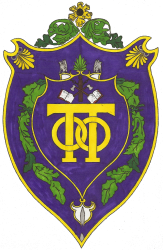
Fraternity crests are designed to reflect the values, history, and identity of the organization and often carry considerable symbolism and history. Notable elements in the OPiO crest include the purple background, gold border, yellow flowers and green leaves, green laurel branches, interlocking “O” and “Π”, and crossed books.
Purple Background
Historically, the most famous purple dye, Tyrian purple, was made from the secretions of the spiny dye-murex snail. This rare and expensive dye symbolized wealth and power. Here it represents the fraternity’s value of academic excellence and anticipated important roles in society.
Yellow Border
Gold, first used as currency around 600 BCE in Asia Minor (modern-day Turkey), has unique properties of durability and scarcity, making it ideal as a medium of exchange. Its use continued in Egypt, Lydia, and the Roman Empire, and the gold standard more recently served as the basis for international monetary systems. Our members often sport a more subdued deep blue and gold combination.
Yellow Flower with Green Leaves
Flowers can signify growth, beauty, and renewal. The green leaves add a sense of vitality and life.
Green Laurel Branches
Laurel branches are traditional symbols of victory, honor, and accomplishment.
Interlocking Letters “O” and “Π”
The letters Omicron and Pi represent the fraternity’s name, Omicron Pi Omicron. Their interlocking nature symbolizes unity and brotherhood.
Crossed Books
These could represent knowledge, enlightenment, and the guiding light of wisdom.
Greek History in Potsdam
A history of Greek organizations in Potsdam can be found here.